
They Built It to Addict Your Kids. Then They Protected Their Own.
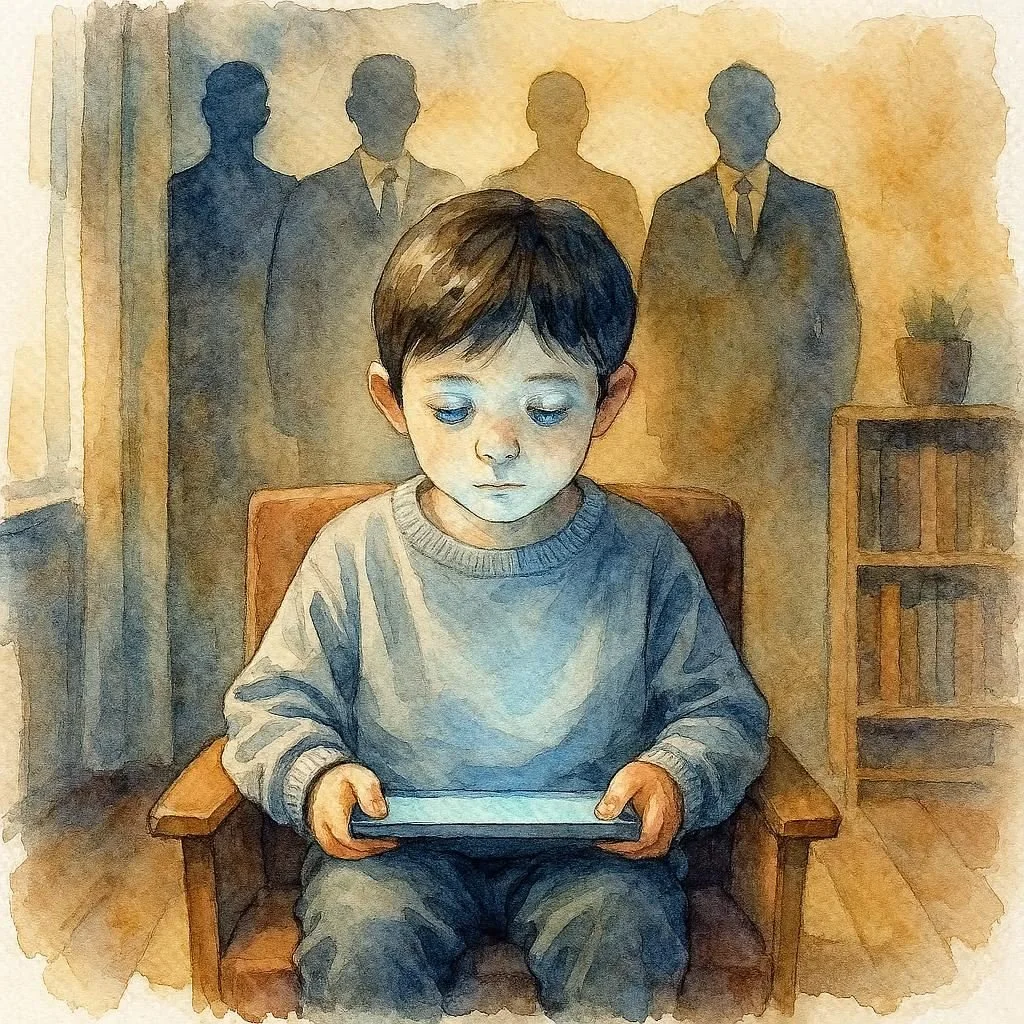
In 2010, a journalist from the New York Times asked Steve Jobs whether his kids loved the iPad. Jobs paused. Then he said something that should have stopped every parent in the world dead: “They haven’t used it. We limit how much technology our kids use at home.”
This wasn’t a man who didn’t understand what he’d built. This was the man who built it. And he looked at what it did, the dopamine loops, the compulsive checking, the erosion of attention, and he decided his children would be protected from it.
Your children were not given the same courtesy.
• • •
The Pattern Nobody Talks About
Jobs wasn’t an outlier. Once you start looking, the pattern is everywhere, and it is damning.
Bill Gates didn’t let his children have smartphones until they turned 14. He banned phones at the dinner table. Not because he was old-fashioned, it was because he understood exactly what those devices were designed to do to a developing brain.
Peter Thiel, one of the earliest investors in Facebook, the man who helped fund the machine, told an audience at the 2024 Aspen Ideas Festival that his young children are allowed ninety minutes of screen time per week. The audience gasped. Ninety minutes a week. Your child is probably averaging that before breakfast.
Evan Spiegel, the CEO of Snapchat, a platform built on disappearing content, streaks, and social pressure, restricts his own child to the same 90 minutes per week.
Neal Mohan, the CEO of YouTube and Time’s 2025 CEO of the Year, admitted publicly that he limits his children’s access to YouTube and other platforms. The man who runs the largest video platform on earth won’t let his own kids use it freely.
Steve Chen, YouTube’s co-founder, went further. He warned that short-form content — the very product his platform pioneered, leads to shorter attention spans. He said he wouldn’t want his kids consuming it.
And Elon Musk, who bought an entire social media platform, admitted that not setting rules on social media for his own children “might’ve been a mistake.”
The people who engineered the machine don’t let their own children anywhere near it. Ask yourself why.
• • •
They Knew. They All Knew.
This isn’t just about personal parenting choices. These executives had access to information you didn’t.
In November 2017, Sean Parker, the founding president of Facebook, sat down with Axios and said the quiet part out loud. He described how Facebook was designed from the ground up around a single question: “How do we consume as much of your time and conscious attention as possible?”
The answer, Parker explained, was a “social-validation feedback loop”, engineered dopamine hits delivered through likes, comments, and notifications. He called it “exactly the kind of thing that a hacker like myself would come up with, because you’re exploiting a vulnerability in human psychology.”
Then he said nine words that should haunt every parent: “God only knows what it’s doing to our children’s brains.”
A month later, Chamath Palihapitiya, Facebook’s former Vice President of User Growth, stood at Stanford and said he felt “tremendous guilt” for what he’d helped build. He said the dopamine-driven feedback loops his team created were “ripping apart the social fabric of how society works.”
And what about his own children? “They’re not allowed to use this shit.”
Read that again. The man who built Facebook’s growth engine won’t let his own kids use it. And he said so publicly, in 2017.
And then there was Tristan Harris. A design ethicist working inside Google on Gmail, one of the most-used products on earth. Harris watched from the inside as every design decision was optimised to capture attention: the notification sounds, the pull-to-refresh, the unread count glowing red. He later said he was personally addicted to the email product he was helping build, and that nobody at Google was interested in making it less addictive. They were too busy choosing the right colours for the inbox.
In 2013, Harris wrote a 141-slide internal presentation titled “A Call to Minimize Distraction & Respect Users’ Attention.” It spread to five thousand Google employees. It laid out exactly how their products were exploiting human psychology. The response? Head nods. Then everyone went back to work.
Harris left Google in 2016 and co-founded the Center for Humane Technology. He went on to star in the Netflix documentary The Social Dilemma, where he told millions of viewers what he’d been saying internally for years: these products are not neutral tools. They are designed to exploit vulnerabilities in the human brain. And the people who designed them know it.
They understood consciously what they were doing. And they did it anyway. — Sean Parker, founding president of Facebook
• • •
The Data They Buried
It got worse.
In 2021, Facebook whistleblower Frances Haugen leaked thousands of internal documents to the Wall Street Journal and the United States Congress. The documents revealed that Meta, the company formerly known as Facebook — had conducted its own research on the impact of Instagram on teenage mental health.
Their findings were devastating. Facebook’s own research found that 32% of teenage girls who felt bad about their bodies said Instagram made them feel worse. Their internal research found that 13.5% of teenage girls in the UK said Instagram worsened their suicidal thoughts. And 17% of teenage girls said Instagram contributed to their eating disorders.
Meta knew this. They had the data in hand. And their response was not to protect children. It was to bury the research and continue developing Instagram Kids, a version of the platform designed specifically for children under 13.
Frances Haugen told Congress in plain language: “Facebook, over and over again, has shown it chooses profit over safety.”
She was right. And the executives who ran these companies knew she was right — because they’d already made a different choice for their own families.
• • •
So What Does That Make You?
Here’s what this comes down to.
A group of people with access to proprietary research on the neurological impact of their products looked at the data, understood the harm, and protected their own children. Then they went back to work and continued selling those same products to yours.
They made billions. Your child got the dopamine loop.
Peter Thiel’s kids get 90 minutes of screens a week. There are studies that suggest Australian teenagers are averaging 7.5 hours a day. The Australian Institute of Family Studies reports that a majority of Australian children are spending time on screens well above the recommended 2-hour daily limit. And that’s just the recreational use, it doesn’t count schoolwork.
This is not a parenting failure. You were never given the same information these executives had. You were never told that the apps your child uses were specifically engineered to exploit vulnerabilities in the developing brain. You were sold “connection” and “creativity” and “learning.” You were sold a product by people who wouldn’t let their own kids touch it.
You are not a bad parent. But you need to know what you’re dealing with. Because the people who built it have always known.
• • •
What You Can Do Right Now
You can’t un-ring the bell. But you can start making decisions with the same information they had.
Know what you’re dealing with. These are not neutral tools. They are products engineered by teams of behavioural psychologists and neuroscientists to create compulsive use. The “just set boundaries” advice fails because it ignores the fact that the product was designed to override boundaries.
Start with yourself. Your face is the first screen your child ever looked at. If your phone is in your hand during dinner, during pickup, during bedtime, you’re modelling exactly the behaviour you’re trying to change. The tech CEOs didn’t just restrict their kids. They changed how technology functioned in the whole household.
Get the facts. The Not Broken Parent Checklist is coming soon, a simple, evidence-based tool that helps you understand where your family sits and what your next step looks like. Keep an eye on the Resources page. In the meantime, start with one screen-free meal a day. Just one. See what happens.
• • •
The people who built the machine made a choice. They chose to protect their children and profit from yours.
Now you know. And now you get to choose too.
The Not Broken Parent Checklist is coming soon → notbroken.net.au/resources
References & Sources
Bilton, N. (2014). Steve Jobs was a low-tech parent. The New York Times, 10 September 2014.
Parker, S. (2017). Interview with Axios at the National Constitution Center, Philadelphia, November 2017. Reported by Axios, NBC Bay Area, CBS News, Engadget.
Palihapitiya, C. (2017). Interview at Stanford Graduate School of Business, November 2017. Reported by The Verge, Fortune, Gizmodo, BBC News.
Harris, T. (2013). A Call to Minimize Distraction & Respect Users’ Attention. Internal Google presentation, 141 slides. Published by The Verge, May 2018. Harris was Google’s Design Ethicist 2013–2016; co-founded Center for Humane Technology, 2016. Featured in The Social Dilemma (Netflix, 2020).
Haugen, F. (2021). Testimony to United States Senate Commerce Subcommittee on Consumer Protection, 5 October 2021. Internal Facebook documents published by The Wall Street Journal (The Facebook Files series).
Quiroz-Gutierrez, M. (2026). Peter Thiel and other tech billionaires are publicly shielding their children from the products that made them rich. Fortune, 21 February 2026.
Time Magazine (2025). Neal Mohan named CEO of the Year; confirms screen limits for his own children.
Chen, S. (2024). Remarks at Stanford Graduate School of Business on short-form content and attention spans.
Australian Institute of Family Studies. Children’s screen time. Canberra: AIFS. Available at: aifs.gov.au
Australian Institute of Health and Welfare. (2024). Screen time guidelines for children and young people: recommended maximum of 2 hours recreational screen time per day for children aged 5–17.
Brushe, M.E. et al. (2023). Objectively measured infant and toddler screen time: findings from a prospective study. SSM — Population Health, 22, 101395.
Online Safety Amendment (Social Media Minimum Age) Act 2024. Parliament of Australia. Restricting social media access for individuals under 16, effective December 2025.
1. “Peter Thiel lets his kids use screens for 90 minutes a week. Your child is averaging that before breakfast.”
2. “The people who engineered the machine don’t let their own children anywhere near it. Ask yourself why.”
3. “You are not a bad parent. But you need to know what you’re dealing with. Because the people who built it have always known.”
4. “They made billions. Your child got the dopamine loop.”
5. “Facebook’s founding president said ‘God only knows what it’s doing to our children’s brains.’ That was 2017. It’s 2026. We know now.”
NOT BROKEN | notbroken.net.au
